
If you manage Google Ads campaigns, you have probably felt the change in Google Ads campaigns. Google Ads campaigns are always changing. Every manager of Google Ads campaigns sees how the platform has moved. The reports look different. The recommendations sound different. The old habit of judging Google Ads campaigns by clicks and conversions does not tell the whole story anymore. AI‑powered advertising is not a buzzword going into 2026. AI‑powered advertising quietly rewrites how marketers read their data.
The change isn’t really one flashy new feature. It’s about a shift in the question we ask. For years, campaign reporting has answered: “what happened?” Now, with AI-powered advertising and Google Ads measurement 2026 tools layered into the account, the useful question is “why did it happen and what should we do next?” That reframe changes everything from budget allocation to how a marketer defines success.
For businesses looking to build a stronger online presence, exploring professional digital marketing services can be a valuable next step alongside effective Google Ads campaigns.
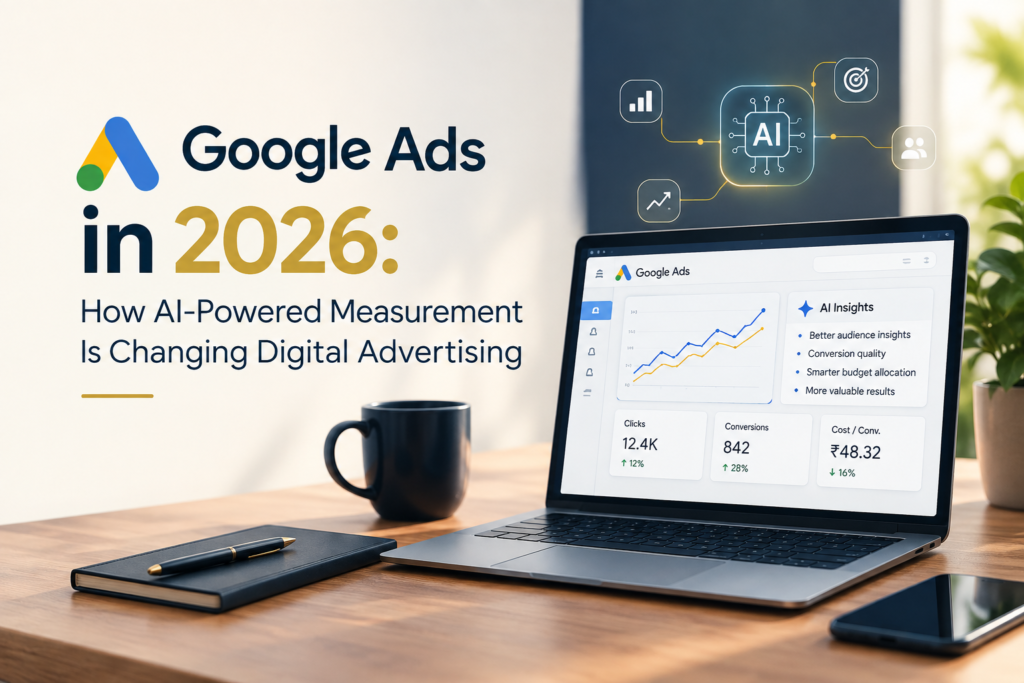
From Clicks to Context: The Real Shift in Google Ads Measurement
Reporting trains marketers to watch a narrow set of numbers: clicks, CTR, CPC, conversions. Those metrics aren’t wrong. They’re incomplete. They tell you an action happened. Not whether that action mattered.
AI marketing analytics adds a layer traditional dashboards never had: pattern recognition across signals that would take an analyst far longer to connect manually. Instead of looking at conversions in isolation, you start looking at:
• Audience behavior across the funnel, not just the last click
• Conversion quality. Not just conversion count
• Customer journeys across multiple touchpoints and devices
• How different signals interact rather than move in isolation
This doesn’t replace thinking. It changes what you have time to think about. Instead of spending your energy tallying up individual metrics, you can spend it deciding where to allocate budget based on the fuller picture those signals paint.
It’s worth being honest: this shift is still early for a lot of marketers, myself included. I haven’t yet had an ” aha” campaign moment where AI-powered measurement flipped a specific client decision overnight. What has changed is the framework I use to make decisions. That’s probably more valuable because it works for every account, not one.
AI-powered advertising is not a buzzword going into 2026. Artificial intelligence (AI) is increasingly being used to analyze data, identify patterns, and support marketing decisions.
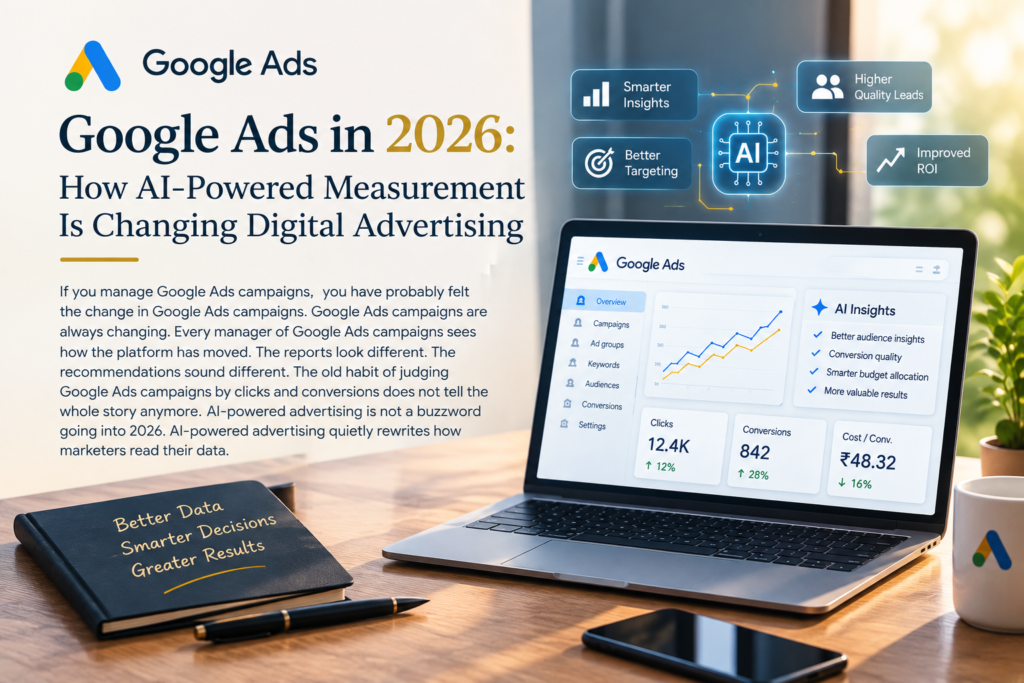
Why Context Matters Than Conversion Volume
A campaign can bring in hundreds of conversions and still fail to create real business results. That is why looking at conversion volume can sometimes give marketers an incomplete picture of how a campaign is performing.
Imagine two campaigns that bring in the number of leads. At glance both campaigns look equally successful.. One campaign might win customers who truly care about the product while the other might only get enquiries that rarely go beyond the first interaction.
This is where context becomes important.
AI‑powered measurement can help marketers spot patterns across signals instead of treating every conversion as the same. Factors such, as audience behaviour, engagement, conversion quality, revenue and the journey after the first conversion bring context.
The goal is not to ignore metrics. Instead marketers can use those metrics as part of a picture. A click tells you that someone looked at an ad. A conversion tells you that a specific action happened.. Understanding what happened after that action gives a much clearer view of business value.
This shift encourages marketers to think beyond short‑term campaign numbers and focus on what the numbers mean.
The Mistake Most Marketers Are Still Making
Here’s the trap: treating every conversion as valuable.
A conversion can look great sitting in a dashboard. A lead form filled out, a purchase completed, a call tracked. Without telling you anything about whether it’s the right conversion. If you focus on numbers, you might end up teaching your ads to look for actions that seem nice on a report but don’t pay attention to whether the leads are good or if people really want to buy or what happens after someone makes a purchase.
This is one of the reasons AI-driven advertising’s valuable in 2026: it helps you look beyond simple conversion numbers and think about whether those conversions are helping the real business goals, not just making a chart look better.
A Simple Framework for Prioritizing Conversion Quality
If you want to start factoring in quality instead of chasing volume, you don’t need a complex overhaul. A practical three-step approach works:
1. Define quality. Decide what a valuable conversion looks like for your business. Purchase value, a real enquiry, a relevant customer type, or a strong likelihood of becoming a paying customer. This step has to happen before any tool can help you because AI can’t guess what “valuable” means to your business.
2. Connect the signals. Look past the conversion event. Compare it against quality, conversion-to-customer rate, revenue, and downstream customer value.
3. Optimize toward value. Once you can see which signals actually correlate with business outcomes, use those. Not raw conversion count. To guide bidding, targeting, and budget decisions.
A simple rule of thumb explains it all: don’t just ask “how conversions did we get?” Ask “how many of those conversions really made a difference to the business?”
Where AI-Powered Measurement Still Needs a Human in the Loop
It’s tempting to treat AI recommendations as correct. Especially when the platform presents them with confidence. That is a mistake that deserves to be named because trustworthy advice means being honest about limits, not the good side.
AI-powered measurement is only as good as the data and signals that feed it. The data and signals can be flawed. Attribution gaps, incomplete customer journeys, shifting user behavior, and data quality issues can all quietly distort what the AI is seeing. None of that means the technology is not useful.
The rule I’d suggest keeping in mind through 2026: use AI to find the patterns and use judgment to understand the context and decide what action actually makes sense for the business. Patterns without context can point you in the direction just as easily as they can point you in the right one.
How Google Ads Is Changing With AI-Powered Measurement
Google Ads is changing. Google Ads is changing the way Google Ads marketers measure campaign performance. In the past Google Ads marketers focused on clicks, conversions, CPC and other familiar numbers. These numbers are still important.. These numbers do not always show what is really happening behind the results.
Now with AI playing a role Google Ads marketers can see signals. Google Ads marketers can find patterns that’re hard to notice just by looking at single numbers. This helps answer questions. Are we reaching the people? Are the conversions actually worth something? What happens after someone converts?
For example a campaign might bring in a lot of leads. That does not always mean it is reaching customers. Some leads might turn into paying customers. Others might never respond again. Seeing this difference gives a picture of how a campaign’s really doing.
Using Google Ads Data to Understand Customer Behaviour
People rarely move in a line from seeing an ad to becoming a customer.
Someone might click on a Google Ads ad visit the website leave and come back a day later. Then they finally submit an enquiry. Make a purchase. They might even use another device. They might interact with the business through a channel before making a decision.
If Google Ads marketers only look at the click or the final conversion Google Ads marketers miss a lot of that journey.
This is where looking at signals becomes very helpful. Audience behaviour, conversion quality, customer journeys and real business results can give Google Ads marketers context when reviewing Google Ads performance.
AI can find patterns in amounts of data. That does not mean Google Ads marketers should accept every pattern as truth. Someone still needs to understand what is happening. Google Ads marketers need to ask if the insight actually makes sense for the business.
Making Better Google Ads Decisions With Conversion Quality
One thing Google Ads marketers need to pay attention to is conversion quality.
Getting conversions sounds good. More conversions do not always mean results. Imagine two Google Ads campaigns. One creates 100 enquiries. The other only creates 50 enquiries. At first the first one looks better.
What if only 10 of those 100 enquiries become customers? What if 20 of the 50 enquiries from the campaign become paying customers?
That changes everything.
When Google Ads data connects with business outcomes campaign performance becomes much easier to understand.
The Future of Google Ads Measurement
The future of Google Ads measurement is not about collecting data. The future of Google Ads measurement is about making the data that Google Ads already have more useful.
As AI tools keep improving Google Ads marketers may have ways to spot patterns across campaigns, audiences and customer journeys. Good data and clear business goals still matter.
AI can find patterns. Google Ads can give signals. Google Ads marketers still need to add context, experience and judgment to the process.
For me the biggest change is not that AI is taking over Google Ads measurement. It is that Google Ads marketers now have another tool to help them ask questions about their campaigns.
Of stopping at “How many conversions did we get?” the better question is:
“How many of those conversions actually made a difference to the business?”
That shift, in thinking can make Google Ads measurement more meaningful.
FAQs
Does AI-powered measurement replace Google Ads metrics like clicks and CPC? No. Clicks, CTR, and CPC still matter. They just aren’t the picture anymore. AI-powered measurement adds context around those numbers rather than replacing them.
What’s the fastest way to start improving conversion quality? Start by defining what a valuable conversion actually looks like for your business before you touch any bidding strategy. Without that definition, no amount of AI analysis will point you in a direction.
Is AI advertising reliable enough to trust without checking it? Not entirely. It’s a tool for spotting patterns in large volumes of signal data, but attribution gaps and data quality issues mean human judgment still needs to validate what the AI is recommending.
The Takeaway
Going into 2026, the marketers who get the most out of AI advertising won’t be the ones who blindly trust every recommendation. They’ll be the ones who use these tools to ask better questions. Move past “what happened”. Toward “why did it happen and what should we do next?” Define what a valuable conversion looks like for your business. Keep human judgment in the loop because AI marketing analytics is built to support decisions, not replace the person making them.
conclusion
Artificial intelligence is changing the way marketers look at Google Ads in the year 2026. The attention is moving away from looking at clicks, conversions and other single numbers. Instead the focus is on understanding the quality, the situation and the value for the business behind those numbers.
The aim is not to take the place of Google Ads numbers or the thinking of people. Instead artificial intelligence can help marketers link signals see patterns understand how good the conversions are and make better choices about how much to bid, who to target and where to spend money.
The biggest change is very simple: of only asking “What happened?” ask “Why did it happen and what should we do next?”
As intelligence, in advertising keeps getting better marketers who use the insights from AI along with good data and their own thinking can use measurement not just to show results but to learn what really helps the business grow.
The real chance is in figuring out what those signals really mean. Clicks, CTR, CPC and conversions are still important. They are a part of the full picture. A conversion also needs to be looked at based on its quality how it connects to the customer journey and how it helps the business.
This is where AI-powered measurement can be helpful. By connecting signals and finding patterns in audience behavior, conversion quality and customer journeys AI can help marketers go from showing campaign activity to understanding what really leads to results.
At this point AI should not be seen as the source of truth. Problems with data quality missing pieces in attribution, customer journeys and changes in how people act can influence the signals that AI uses. Human thinking is still needed to understand the reason behind the suggestions and decide if an action makes sense for the business.
For marketers the aim in 2026 should not be to gather numbers or follow many suggestions. The aim should be to ask questions decide what a good conversion means connect the signals and work, towards real business results.
The future of Google Ads measurement is therefore not just AI taking over measurement. It is AI helping marketers understand Google Ads measurement better.
The main way to think about this is simple:
Don’t just track what happened in Google Ads measurement. Understand why it happened what it means and what should happen next.