
If you have noticed your search traffic behaving strangely this year, you are not imagining it. Google AI Mode SEO is quickly becoming one of the most important conversations in digital marketing and for good reason. Since its 2025 launch, AI Mode has grown into a part of how people search. At Google I/O 2026, the company confirmed that this marks the first major redesign of the Search experience in over 25 years.
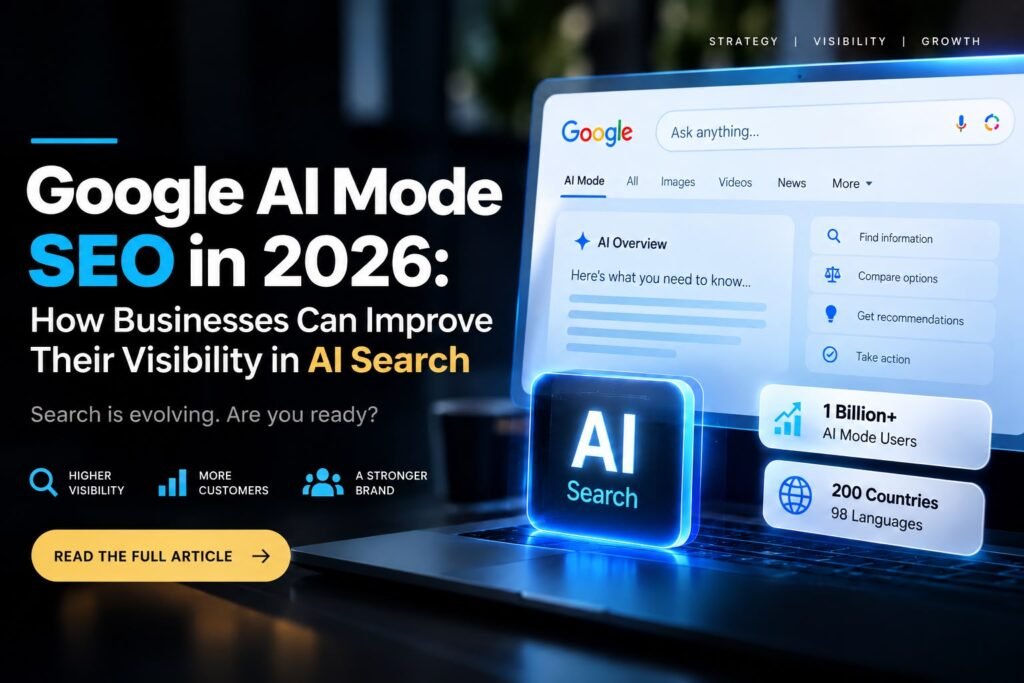
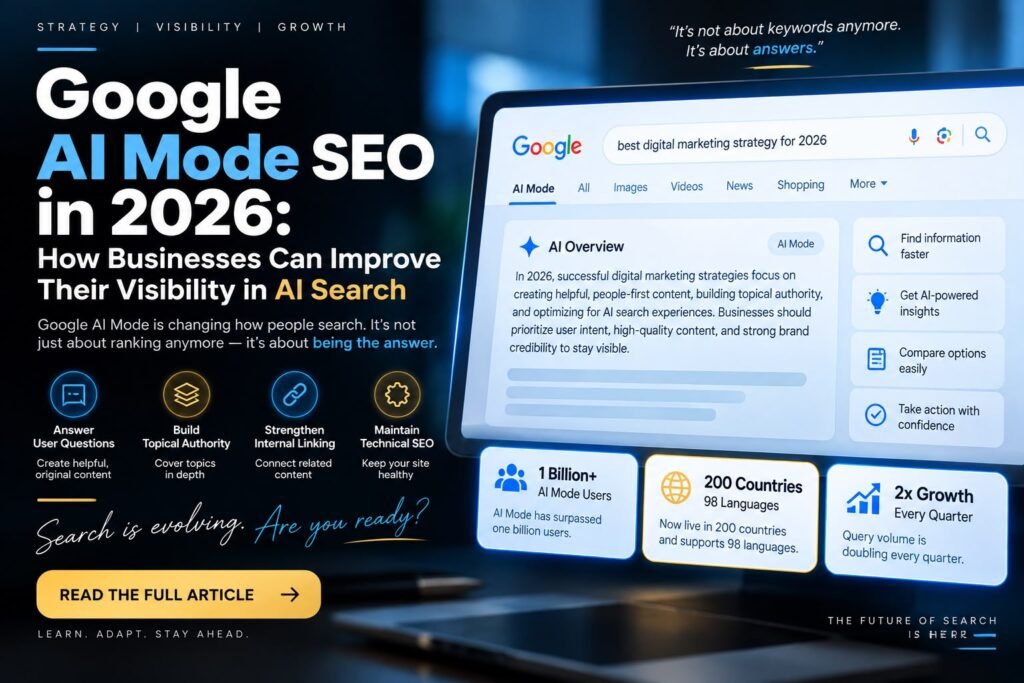
The scale is hard to ignore. Google shared that AI Mode has surpassed one billion users, with query volume doubling every quarter. The feature is now live in 200 countries and supports 98 languages, running on the Gemini 3.5 Flash model as the new default across Search. Google turns Search into an AI Assistant with agents, a Generative UI, and personal intelligence
So what does this really mean for your company? What actions should you take?
I have been tracking this shift closely through my marketing work. Here is what I have learned.
It is Not About Ranking Anymore. It is About Being the Answer
The biggest change is not that traffic has simply dropped. It is that visibility itself works differently now. Instead of always clicking through several blue links, users can get a detailed AI-generated answer right inside the search experience. That means your site can influence what a customer sees and gains trust without a click.
This shifts the SEO job. Ranking for one keyword matters less than building authority. It is better to answer questions and structure content so it is easy to read and earn trust signals that stay strong no matter whether a human or an AI system looks at the page. Longer conversational searches matter too. People can now ask questions instead of typing short keyword fragments.
The takeaway is not to abandon SEO. It is to evolve SEO. That means:
• Creating original content
• Answering user questions
• Building topical authority around important subjects
• Using descriptive, scannable headings
• Strengthening internal linking
• Maintaining technical SEO
• Monitoring how your site shows up across Google’s evolving search experiences
How to Build Topical Authority for AI Search Visibility
Topical authority does not come from a keyword list. It comes from mapping the questions someone asks before, during, and after they search.
Start With Intent, Not Keywords
A practical process looks like this:
1. Start with the topic. Identify what someone genuinely wants to understand or accomplish.
2. Check. Questions. Google’s autocomplete, People and related searches surface recurring variations.
3. Study the existing search results for the topic. If several results already cover the sub-question, that is usually a signal of intent.
4. Group questions by type. How‑to, comparison, and problem‑solving. Rather than writing an article for every keyword variation.
5. Build the cluster around one page with supporting articles that go deeper into questions, linking together where the connection is genuinely useful.
Validate With Data Don’t Lead With It
Tools like Google Search Console, Google Trends, and keyword research platforms are useful for validating demand and finding angles. They should confirm your direction, not dictate it. A cluster built around Google AI Mode SEO, for example, might naturally branch into how AI Mode works, AI Mode versus search-optimizing content for AI search, and how to monitor AI search performance.
5 Mistakes Businesses Make When Adapting to AI Mode
The common mistake is writing for the algorithm of the person searching. Watch out for:
1. Keyword stuffing AI‑related terms. Repeating “AI search,” “AI Mode,” or “AI Overviews” does not make content more visible. It still has to answer the question.
2. Rewriting content to sound “AI‑friendly.” Clear structure helps. Stripping out context and examples to sound robotic hurts more than it helps.
3. Publishing dozens of near‑duplicate pages. Covering questions comprehensively with smart internal links beats a page for every micro‑variation.
4. Ignoring SEO fundamentals. I think crawlability, site structure, and authority still matter.
AI search is an evolution of search, not a replacement for it.
5. Chasing visibility without checking outcomes. Appearing in an AI‑generated answer does not automatically mean traffic or conversions. Track it in Search Console and analytics.
AI Mode SEO vs. SEO
| Focus Area | Traditional SEO | AI Mode SEO |
|---|---|---|
| Primary Goal | Rank for a keyword | Be a source referenced in an answer |
| Content Shape | Standalone pages | Interconnected topic clusters |
| Query Style | Short keywords | Longer conversational questions |
| Success Signal | Clicks and rankings | Clicks, impressions, and answer visibility |
| Foundation | SEO fundamentals are still required | SEO fundamentals are still required |
Your First Step: A One‑Page Audit You Can Do This Week
Do not change your strategy all at once. Pick one page that already gets traffic or answers a customer question and ask yourself:
• Does it answer the main question clearly within the first few sections?
• Does it cover the questions a customer would naturally ask next?
• Are the headings descriptive and easy to scan?
• Does it offer information or examples that go beyond surface‑level coverage?
• Does it link to relevant pages on your site?
• Is it written for the customer, not for a keyword?
Improve that one page, then monitor its impressions, clicks, and average position in Google Search Console over the following weeks. Once you see what works, repeat the process on your pages.
FAQs
Does Google AI Mode SEO replace SEO?
No. Technical SEO, crawlability, and content quality remain the foundation. AI Mode changes how visibility happens, not whether SEO fundamentals matter.
How long does it take to see results from AI Mode optimization?
Because AI Mode surfaces are still evolving, treat this as monitoring rather than a fixed timeline. Watch Search Console data over weeks and months rather than expecting overnight change.
Should I create content for AI Mode?
No. Create well‑structured content for your actual audience. Content built to manipulate an AI response tends to underperform content built to genuinely help the reader.
Google AI Mode is not eliminating SEO. I see that it is changing what SEO means. The businesses that adapt well will not chase AI tricks; they will double down on answers, real expertise, and content arranged around how people actually search. Start with one page, apply the audit above, and build outward from there.
How to Make Your Content Easier for AI Search to Understand
One of the ways to get ready for AI search is to make your content easier to understand. This helps both people and search systems.
Start by making it clear what each page is about. A visitor should know the idea away without having to read an introduction.
Use a heading two to break up the content into sections
Use a heading three to break up the content into sections. If your page answers many related questions organize them in a way. Don’t mix information together.
For example an article about Google AI Mode SEO could have sections like:
* What is Google AI Mode?
* How does AI Mode change the way people search?
* How can businesses improve content for AI search?
* What role does topical authority play?
* How should businesses track their results?
This kind of structure makes the article easier to scan. I find it helps readers find what they need quickly.
Focus on First-Hand Value and Original Information
As more content gets created by AI just copying what’s already online won’t help much. Repeating details doesn’t add value.
Try to include something that makes your page better than others. You can do this by adding:
* Your Insights
* Real-life examples
* Step-by-step guides
* explanations you came up with
* Data when helpful
* Comparisons that show differences clearly
* Answers to questions that other articles miss
The goal is not to write just because AI search exists. The goal is to make content that a person would actually find useful.
Build Connections Between Related Content
Having a topic cluster isn’t about publishing posts. The posts also need to connect
Imagine a site has pages about Google AI Mode, AI Overviews, AI search optimization and AI-powered ads. These pages can be linked together where one expands on another.
For instance when talking about AI search optimization you might link to an article on Google AI Overviews if someone wants to learn more.
This builds a content path. It helps users go from ideas to ones.
Don’t Forget the User Experience
Optimizing for AI search shouldn’t mean ignoring how users actually experience your site.
A visitor who clicks through from a search still needs a page thats easy to read and move around on.
Make sure these things are solid:
* Fast page loading speed
* mobile performance
* Clear navigation
* Easy-to-read text
* Short paragraphs
* Helpful headings
* Logical internal links
* Clear calls to action
* Contact or business info that’s easy to find
If your content draws attention but the page is hard to use visibility won’t lead to results.
## How to Measure Your Progress
There is no number that tells you whether your website is doing well in AI search.
Instead watch signals over time.
Google Search Console gives you details on impressions, clicks, queries and ranking position. Your analytics tool can show how visitors behave and whether they convert.
Look at questions like:
* Are more people seeing your page for searches?
* Are types of queries bringing traffic?
* Are pages becoming more visible?
* Are visitors actually Engaging?
* Are people taking actions after visiting?
The aim isn’t to appear in an AI answer. The bigger goal is to build visibility that leads to traffic, trust and business results.
A Simple AI Search Content Strategy for Small Businesses
Businesses don’t have to rebuild everything to start adapting to AI search.
A simple plan is to begin with topics that matter most to customers.
Pick one service or product. Then list the questions customers often ask about it. Create one resource. Build supporting content around those same themes.
For example a digital marketing agency might focus on:
topic: Digital Marketing Strategy
Supporting topics:
* SEO strategy for businesses
* Local SEO
* Google Business Profile optimization
* Social media marketing
* Google Ads
* Content marketing
* Measuring marketing performance
Each supporting article answers a need. Links naturally to other parts of the network.
This creates an information system of a pile of blog posts.
CONCLUSION
Google AI Mode is changing how people find and use information. That doesn’t mean businesses have to drop SEO methods.
The big shift is in thinking about visibility.
Than focusing on keywords businesses should aim to be a source of useful information. That means answering questions, building expertise in an area creating content linking related pages and keeping the site technically strong.
You don’t need to try every technique at. Start with something
Pick one page. Look at it as a real customer would. Improve the answers and layout. Then check results in Google Search Console and your analytics.
AI search will keep changing. The businesses that succeed will be those focused on the basics: information, real expertise, clear content structure and a good experience for the people they want to reach.
Google AI Mode is not the end of SEO. It is another step in how search works. The best place to begin is, with the content you already have.